4 Essential SEO Reporting Tools for 2026: Mechanisms and Limits
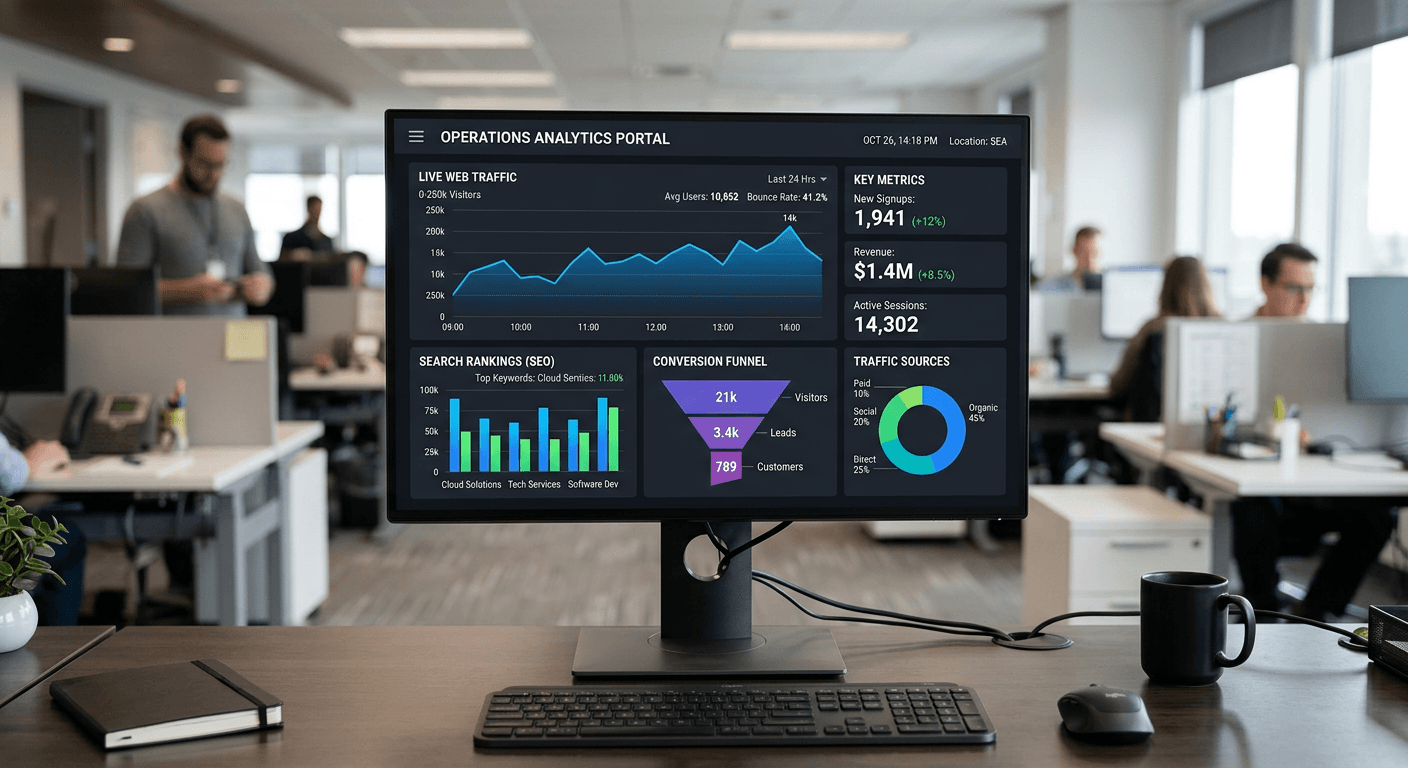
The moment a client or internal stakeholder asks why a sudden drop in organic traffic hasn't been flagged, the gap between having raw data and having actionable seo reporting tools becomes painfully obvious. Too many operations rely on fragmented spreadsheets or wait until the end of the month to manually stitch together performance metrics across different channels. This reactive approach leaves businesses blind to algorithm shifts, competitor movements, and technical breakages as they happen in real time. Establishing reliable visibility requires moving away from static exports and implementing systems that continuously capture, analyze, and present search metrics accurately. This guide breaks down the mechanisms separating the leading platforms on the market, examining exactly how they source their data, where their commercial models restrict scale, and which infrastructure actually suits your operational bottleneck.
Quick Summary
Effective reporting infrastructure centralizes keyword rank tracking, technical site health auditing, and competitor intelligence into a unified interface. Rather than treating search data as a passive archive, these platforms actively query search engines and crawl the web to provide near real-time visibility into digital performance.
- Proprietary crawler suites run their own backend infrastructure to map the web and generate native backlink intelligence.
- Visualization platforms rely entirely on API connections to pull existing metrics into a unified client portal.
- Data latency and update frequency dictate how quickly a team can react to sudden ranking drops.
- Seat licensing and project caps function as the primary commercial levers that control total cost of ownership.
Table of Contents
- Comparison Table
- Buying Guide: Evaluating Reporting Architecture
- 1. Semrush
- 2. SE Ranking
- 3. AgencyAnalytics
- 4. Ahrefs
- Mapping Architecture to Your Operations
- Recommended Reads
Comparison Table
| Product | Reporting Architecture | Features | Pros | Cons | Target Audience |
|---|---|---|---|---|---|
| Semrush | Full-Stack Crawler Suites | Keyword research, site auditing, backlink analysis | Massive proprietary database, consolidated interface, deep technical audits | Strict daily report caps on free tier, expensive seat licensing, overwhelming UI for beginners | In-house enterprise teams |
| SE Ranking | Full-Stack Crawler Suites | Rank tracking, white-label reporting, auditing | Granular local tracking, agency reporting add-ons, transparent project limits | Base tier project caps, interface slows at scale, separates agency tools into an add-on | Mid-sized agencies |
| AgencyAnalytics | Aggregated Client Reporting Platforms | API data aggregation, custom dashboards | Broad integration ecosystem, unlimited client seats, low friction visual setup | Lacks native crawler data, rank tracking costs extra, dependent on existing tech stack | Client-facing marketing firms |
| Ahrefs | Full-Stack Crawler Suites | Backlink analysis, competitive intelligence | Industry-leading link index, continuous page discovery, strict technical focus | No free trial available, expensive multi-user scaling, less focus on white-labeling | Technical search professionals |
Buying Guide: Evaluating Reporting Architecture
Mastering seo analytics requires a clear understanding of where your metrics actually originate. The market divides strictly along the lines of Reporting Architecture, separating tools that generate their own insights from those that merely display them. Selecting the wrong category guarantees either paying for computational power you never utilize or lacking the diagnostic depth required when a campaign stalls.
Full-Stack Crawler Suites Platforms in this category operate their own massive backend infrastructure. They deploy fleets of automated bots to continuously crawl billions of web pages, render JavaScript, and map the interconnectedness of domains. Because they own the index, they calculate keyword difficulty, search volumes, and link toxicity using proprietary algorithms rather than relying on third-party estimates. This independence grants users profound technical depth, allowing a search professional to dissect a competitor's exact traffic acquisition strategy. However, maintaining this level of data collection requires significant server power, a cost that is inevitably passed down to the buyer through strict project caps and expensive multi-seat licensing models.
Practical rule: Never evaluate a proprietary crawler purely on its feature list; check its update frequency, as a massive database is useless if the regional SERPs you target are only refreshed once every thirty days.
Aggregated Client Reporting Platforms These systems take the opposite structural approach. Instead of building their own web indices, they function purely as a visualization layer. By leveraging OAuth tokens and API connections, they pull live data streams from various native marketing channels and plot them onto customized, scalable client interfaces. This architecture completely removes the need for in-house developers to build custom dashboards. Because they do not bear the cost of crawling the internet, their commercial models often allow for unlimited client seats and seamless white-labeling. The structural catch is that you must already pay for the backend data sources; an aggregation tool cannot present intelligence that your existing tech stack does not track.
Evaluating an AI-driven SEO platform for US businesses or a traditional manual tracker requires matching these architectures against your internal resources. If your primary bottleneck is diagnosing why pages fail to index, aggregation will not help you. Conversely, if your bottleneck is spending twenty hours a week exporting spreadsheets to prove return on investment to clients, heavy technical suites will only add friction to your workflow.
1. Semrush
Broad visibility requires significant commercial commitment
A complete digital marketing ecosystem built around an enormous proprietary database of keyword and backlink intelligence. Semrush operates by deploying custom web crawlers that continuously map search engine results pages across various global regions, calculating search volumes and identifying complex link profiles before funneling that raw intelligence into highly structured tracking modules.
The platform relies heavily on seat licensing and tiered access to control its infrastructure costs. The entry-level Pro plan requires $139.95 per month, which opens up the core database but restricts multi-user collaboration. While a free plan exists, it severely restricts diagnostic capabilities by limiting users to a single demo project and halting entirely after 10 daily reports. Scaling an internal department quickly multiplies the overhead, as adding additional user seats costs $45 per month explicitly on the base tier.
We would deploy this when an internal marketing department requires deep technical auditing alongside paid and organic keyword intelligence within a single interface, provided the operating budget comfortably absorbs the per-user licensing fees.
Pros
- Consolidates technical, content, and competitive data into one centralized ecosystem.
- Provides deep, proprietary link indices that rival dedicated backlink platforms.
- Offers extensive historical data for granular competitor traffic analysis.
Cons
- Seat licensing scales aggressively for larger teams requiring concurrent access.
- The free tier limits daily queries too strictly for serious operational use.
- The sheer volume of available modules creates a steep learning curve for new users.
2. SE Ranking
Volume tracking heavily favors agency economics
Where enterprise suites force teams into high starting prices, this localized tracker targets agencies needing core rank tracking without the premium overhead. SE Ranking bypasses bloated ecosystem features by querying search engines directly to update keyword positions based on highly localized parameters, packaging the raw tracking metrics alongside dedicated white-label report builders.
The commercial model is built around usage ceilings rather than seat gates. The Core plan starts at $103.20 per month. It grants access to track 2,000 daily keywords. Yet it artificially limits the infrastructure to exactly 10 projects. This is a hard cap. Any scaling operation bringing on an eleventh client must immediately upgrade its tier. Alternatively, they can purchase the $69 per month Agency Pack add-on. This add-on is required to unlock reporting independence and additional client seats.
This setup makes sense for mid-sized operations requiring high-volume tracking limits and polished client portals, assuming they do not need the extraneous paid advertising modules bundled into enterprise alternatives.
Pros
- Delivers highly accurate, location-specific keyword tracking data.
- Pricing is transparent and tied directly to the volume of keywords monitored.
- Features a generous 14-day free trial that allows thorough evaluation before purchase.
Cons
- The base tier restricts users to a very limited number of active projects.
- Essential white-label reporting requires purchasing a separate agency add-on.
- The technical auditing tools lack the depth of heavier, dedicated crawling software.
3. AgencyAnalytics
Visual aggregation replaces native data generation
When managing fifty client campaigns simultaneously, logging into disparate platforms to manually screenshot traffic graphs is the exact bottleneck that sends teams looking for a unified dashboard. AgencyAnalytics solves this by functioning entirely as an API aggregator rather than a data generator, ingesting metrics from over 85 external sources and plotting them onto automated, client-facing interfaces.
The platform does not run its own web crawlers. It operates on a frictionless volume model. You pay $20 per client per month. This allows unlimited connections and staff access. However, this lightweight architecture means native search intelligence is notably absent. Native keyword tracking across standard search engines costs extra. It must be purchased as a separate module for $41.67 per month. This renders the platform heavily dependent on the quality of your existing technology stack. It replaces manual exports from google analytics seo tools. It funnels that existing data into a cleaner view.
Client-facing organizations should implement this if they already possess backend technical tools to diagnose site health but require a polished, low-friction environment to present those aggregated metrics to non-technical stakeholders.
Pros
- Provides seamless integration with an extensive library of external marketing channels.
- Allows unlimited staff and client users without imposing per-seat penalties.
- Drastically reduces the hours spent manually formatting end-of-month performance PDFs.
Cons
- Does not natively crawl the web or generate proprietary technical health data.
- Keyword rank tracking is walled off as an extra, recurring monthly add-on.
- Total software costs rise as it forces reliance on separate backend auditing tools.
4. Ahrefs
Technical depth skips the trial phase
How deep is the backlink index before investing in a technical suite? This platform built its reputation answering that specific question for search professionals. Ahrefs runs a dedicated, high-frequency web crawler designed to discover new links and pages continuously, analyzing domain interconnectedness and translating that raw architectural graph into competitor intelligence and site health scores.
The commercial environment here is uncompromisingly geared toward established practitioners. The entry-level Lite plan requires $129 per month, and unlike nearly every other platform in the space, there is absolutely no free trial available to test the paid tiers. Prospective buyers must either rely entirely on the limited free tier - which verifies site owners for a handful of basic tools - or commit blindly to a commercial plan. Adding collaborators also incurs strict penalties, with extra seats costing $40 per month on the lowest tier.
Technical teams prioritizing backlink acquisition, content gap analysis, and strict diagnostic auditing will find this indispensable, provided they do not require automated white-label client presentation features.
Pros
- Maintains one of the most comprehensive and rapidly updated backlink indices available.
- Excels at uncovering competitor content strategies and historical traffic gaps.
- The free verified-owner tier provides ongoing value for managing owned properties.
Cons
- The strict lack of a free trial forces a blind financial commitment for new users.
- Adding team members significantly inflates the monthly subscription overhead.
- Offers fewer dedicated client reporting and white-labeling tools than agency-focused trackers.
Mapping Architecture to Your Operations
Selecting the proper reporting infrastructure comes down to honestly assessing what your team actually does with the data once it is collected. Website marketing analytics often fail not because the metrics are inaccurate, but because the platform's architecture misaligns with the company's daily workflow.
Teams relying on Full-Stack Crawler Suites typically operate as technical consultancies or in-house diagnostic departments. If your primary mandate is to uncover why a specific cluster of pages dropped out of the index, or to calculate the exact link equity required to overtake a competitor in a major US market, API visualization is insufficient. You require the raw diagnostic power of a platform that actively renders JavaScript and calculates proprietary difficulty scores. The trade-off is accepting the steeper learning curve and the heavy commercial weight of seat licensing.
Conversely, organizations built around Aggregated Client Reporting Platforms prioritize presentation and scale over native discovery. If your business model relies on managing dozens of local service campaigns, the priority shifts from discovering new backlinks to seamlessly communicating value to stakeholders. These teams rely on existing seo monitoring tools for the backend heavy lifting, utilizing aggregation platforms solely to strip away the technical noise. This approach protects margins by avoiding per-seat penalties, ensuring that the agency can scale its client roster without exponentially increasing its software overhead.
Practical rule: Map your software budget directly to your client deliverables; if clients only ever see automated PDF summaries of traffic growth, overpaying for deep technical log-file analysis modules will actively harm your profit margins.
Ultimately, no single platform replaces the fundamental requirement of knowing how to interpret search behavior. The tools merely control how quickly, and at what cost, that behavior is mapped to your screen.